In Ancient Times...
Based on a dream I had in 2022.
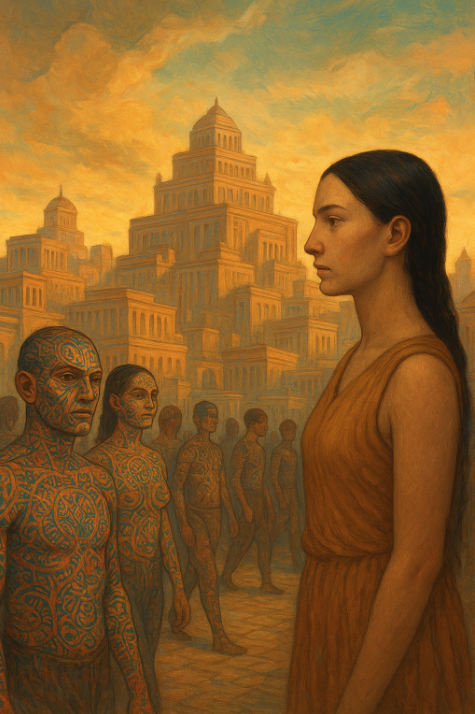
In ancient times there lived an ancient civilization that worshipped humanity. These people were very industrious and built cities unrivaled in their era. These cities grew monstrously large and efficiently housed, fed, and accommodated upwards of a million individuals, which was a great feat in the pre-Industrial times.
Their cities were wonders of the ancient world - great feats of science, engineering, art, and philosophy lined their streets. They showcased their triumphs in all aspects of their society.
Their kingdom was ruled not by a monarch, but by a council of philosophers. Each law that passed was done so with meticulous attention to detail; their debates would rage on for hours. But contrary to today’s debates, these would remain dispassionate and logical, and hatred was not even in their vocabulary. They would consider the pros and cons of something and would argue using philosophical principles rather than emotions. You’d think that they would never have gotten anything done, since they spent so long arguing, but that’s the opposite of the case. They operated under a shared set of values and would not allow emotions and impulses to impede on their values. This allowed them to focus on the real issues. Slander, racial bias, and intolerance were inconceivable to them - it was the inner expanse of the mind that captivated these people.
If one of us could take a stroll down their streets, we would find ourselves in an entirely new world and the people would appear almost alien. Each individual carried themselves in the highest regard, with a straight back and an inflated chest. They walked majestically and talked slowly and soothingly.
But the most stark difference between us and them was their skin! For these people worshipped humanity and valued the inner complexity and contradictory nature of the human mind. They realized that each individual was a complicated mass of thoughts and feelings, of experiences and aspirations. And they recognized the fact that these inner complexities scarcely revealed themselves in an individual’s outer appearance. And so it became a custom in this once-great city to heavily tattoo oneself in symbols and images, as a reminder to oneself and to the individuals surrounding oneself that they, too, were a complex individual. The tattoos were a way to externalize their inner complexities.
It became such that, in the social hierarchy of this civilization, the more numerous and complex an individual’s tattoos appeared, the more human, and thus the more divine, that individual was regarded. And thus it was that the wealthier of the bunch invested immense resources in painting themselves in more and more intricate ink. There were a number of developments in this regard - first, the introduction of multiple colors of ink to symbolize the multifaceted nature of human emotions, and the “colors” of anger and happiness and all other emotions that lie in between. Next, the use of optical illusions was used to signify that what appears at first may not be what truly lies beneath. The people really loved this one. Next, the development of mosaic-style tattoos, where many small images combined to form an overarching image of some entity such as a lion or a throne, was used to portray the constituent parts of their being forming a single, complex and contradiction-riddled individual. Eventually, they took this one step further by creating mosaics made of mosaics. They were truly a creative bunch. At some point, groups of these people banded together to form inter-individual images; each individual would have part of an image and, when they stood in a particular arrangement, often hugging or standing side-by-side, the full image emerged. This was to signify that, although individuals were complex and interesting in themselves, they live in a society and are thus incomplete without their fellow persons. I’m sure you could imagine that group tattoos were all the rage back then.
But what was the effect of all this craze? These tattoos were the physical manifestation of the inner struggles and the inner complexity that each person experienced. And the outer manifestation, that emerged in order to serve as a reminder of this inner wealth, eventually came to replace it, in much the same way that, today, people mistake the paper money they hold to be of more importance than the resources it affords for them.
We can see this shift of priority in these people’s pastimes. They would begin to hold competitions where individuals or groups would compete to show off their luxurious and complicated tattoos. These shows, similar to the Roman gladiator games, would attract massive crowds that would participate in every wretched and vile form of hedonism one could imagine during the intermittent periods between performances. And once all the performers had shown off their physical humanity onstage, the audience would vote on who is the “most human” of the humans. I’m sure you can easily see the irony here. They did as well, but rather than recognize it’s absurdity, they allowed themselves to believe it was just another beautiful contradiction of the human condition.
Over time, these competitions became more lavish and more decadent. Along the way, they lost the love of the humanity they once had and shifted toward the love of the superficial, the love of the images on their skins. What was once a civilization obsessed with humans eventually became a society obsessed with façades.
This was all good and well, until one day, a very wise individual was born and grew up in this society. Her parents taught her the values that the society supposedly worshipped, but she immediately saw the contractions. When she became of age and her parents and friends urged her to get her first tattoo, she declined. “I know my own inner wealth. I do not need pictures on my skin to remind me or anyone else that they exist” she argued.
And so she went her adult life having never gotten a single dot or line of ink. This, you must understand, was highly unusual. People stared at her wherever she went. And people began to think about this - in the sea of ink and images, here was one person who was different. Why did she refuse to conform? they thought. But then, upon having this thought, they realized that she embodied their values more strongly than anyone else. She refused to give into the society’s expectations, and recognized her own inner wealth as being sufficient for her. This was a radical idea at the time, although I’m sure you agree that it is actually anything but. It was the fundamental idea that their civilization was built upon, but the people had become so preoccupied with their obsession that they had gone astray somewhere along the way. And this individual, with her will of steel, embodied the fundamental ideal in its entirety.
She soon rose to fame among these people - the girl who did NOT have a tattoo. It was the ultimate form of expressing one’s inner complexity - by allowing it to remain implicit. This was considered an invention in itself, and caused an enormous social ripple.
And so it went that these people had undergone a full circle. And it became enshrined in the mythology and lore of the civilization that this one person and her realization of the absurdity of their society, was one of the most important historical and philosophical events of these peoples’ history.
Now today, many millennia later, we come to appreciate their transformation. We read their stories and study their ideas, and find their spirits within us. And although their society has since disappeared, we find that they are still very much here.